

Investing in the future of animal-free research: lifETIME CDT
What happens when you bring together some of the brightest young minds in biomedical research? You get a day full of inspiration, innovation and progress – which is exactly what we experienced last week at the lifETIME CDT Student Day in Birmingham!
We had the fantastic opportunity to meet the PhD students that Animal Free Research UK supports, and we heard about their groundbreaking projects, watched them present their research, and saw their passion for replacing animal experiments with cutting-edge science. Their dedication is driving real change, and we couldn’t be more excited about the future of human-relevant research.
What is lifETIME CDT?
The lifETIME (Engineered Tissues for Discovery, Industry and Medicine) Centre for Doctoral Training (CDT) (lifETIME CDT) is a leading UK training programme dedicated to developing next-generation researchers in non-animal technologies. The scheme is a partnership between the University of Glasgow, the University of Birmingham, Aston University and CÚRAM Science Foundation Ireland, which aims to train the next generation of researchers in non-animal technology and regenerative medicine in multidisciplinary, high-value skills.
The scheme brings together expertise from academia, industry and healthcare to create an in-depth 4-year training programme for PhD students, specialising in creating realistic human models for drug testing and disease research to eliminate the need for animal experiments.
During the programme, students undertake a varied range of training and placements in industry and other universities, which is designed to help them network with stakeholders from industry, the NHS, charity, funders and regulators and develop skills which will make them highly employable in future.
Animal Free Research UK is proud to be a strategic charity and funding partner of lifETIME CDT.
Why is this important?
Many scientists begin their careers being taught to rely on animal experiments, simply because that’s the way things have always been done. But lifETIME CDT is helping to equip the next generation of researchers with the knowledge and skills to drive an animal-free future from the very start of their careers.
These PhD students are already making waves in human-specific research, and we couldn’t be prouder. We left the conference feeling energised and hopeful – the future of animal-free science is bright!
We caught up with Professor Matt Dalby, Director of the lifETIME CDT to learn more about the programme and get his thoughts on the Student Day!

Meet the students!
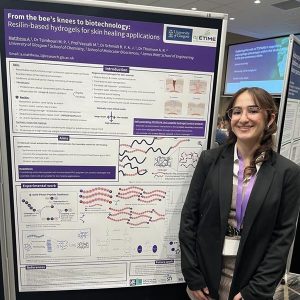 Athena Mattheou
University of Glasgow
Project title: From the bee’s knees to biotechnology: Resilin-based hydrogels for cell-culture and bioprinting
Hydrogels are gel-like structures that are widely used to grow cells and for tissue engineering, but they are usually made from animal-derived materials which can affect the results of experiments using human cells.
Athena’s PhD project explores the use of a synthetic version of a protein called resilin – a highly elastic protein that is found in the connective tissues of insects (literally the “bee’s knees!) – to create ‘tuneable’ hydrogels that provide the perfect environment for human cell growth. These hydrogels will overcome the current limitations of animal-free hydrogels, offering an effective and reliable alternative for human cell-based research.
 Eleanor Barton
Aston University
Project title: Development of a novel in vitro vascular model for analysis of blood flow through medical devices
Cardiovascular disease is the leading cause of death worldwide, and grafts are a vital treatment for repairing or replacing damaged arteries. To better understand cardiovascular diseases and develop new treatments, researchers need a way to visualise blood flow in both healthy and diseased arteries. Currently, this is done using computer simulations and animal experiments, but these methods have limitations.
Eleanor’s PhD project aims to create a realistic, transparent model of the human vascular system using 3D printing and advanced imaging techniques. This model will help scientists study blood flow, test new treatments and replace animal experiments in cardiovascular research. The goal is to have this method recognised by regulators like the FDA and MHRA, paving the way for a more human-relevant future in medicine.
 Shaima Riha
University of Glasgow
Project title: Engineered living biomaterials in humanised multiphasic in vitro models – optogenetics to control the dialogue between the immune system and stem cells
Study of the immune system is key to understanding how our bodies fight off diseases, but most current research relies heavily on animal testing.
Shaima’s project is pioneering a new era of living biomaterials, using genetically engineered bacteria that respond to light to control immune cell behaviour. Using 3D printing and innovative technologies, Shaima will develop animal-free models to study immune responses in a human-relevant way.
 Xally Montserrat Valencia Guerrero
University of Glasgow
Project title: Designing animal-free organoids based on engineered vegetables and protein crystals (VegFold)
When grown in 3D, cells need a supportive structure or ‘scaffold’ to help them grow like they would inside the human body. These scaffolds are usually made from animal-derived products like gelatin or collagen, which can change how human cells behave and lead to unreliable results in experiments.
Xally’s project is developing animal-free scaffolds to use for growing cells using plant-based materials, like fruit and vegetables. By removing the cells from apples, Xally is exploring how their natural structures can be used as a scaffold for growing human stem cells, which is a promising alternative to traditional, animal-based methods.
 Lauren Hope
University of Glasgow
Project title: Developing a 3D model of bone marrow to test drugs for blood cancer
Acute myeloid leukaemia (AML) is a blood cancer that can develop quickly and eventually spread to other parts of the body, including the lymph nodes and the spleen. Only 15% of people survive their leukaemia for more than five years after a diagnosis, so more effective ways of treating this disease are urgently needed.
To better understand AML, Lauren’s PhD project involved using human cells to develop a 3D bone marrow model. The model was used to investigate the role of bone marrow in protecting cancer cells and causing drug resistance, and to test the best combination of therapies that could be taken forward to clinical trials. This model could help replace animal experiments in drug development, leading to safer and more effective treatments for patients.
Lauren was in the first cohort of lifETIME CDT PhD students in 2019 and so she has already graduated! Read Lauren’s blog post to learn more about her experiences of the lifETIME CDT programme.

